• Skip to primary navigation
  • Skip to main content
  • Skip to primary sidebar

Just Plain Living

building a life that bends without breaking

  • About
  • Blog Posts

Sustainable Home

Can Small Organic Farms Feed The World?

August 18, 2025 by marie Leave a Comment

This article was originally published on JustPlainCooking.ca December 18, 2018. If you arrived here from a recipe post, welcome to Just Plain Living, where we talk about the bigger questions behind food, community, and sustainability!

Can small organic farms feed the world or can only conventional, chemical farming can feed the nine billion population expected by 2050?

The most common criticism against organic farming (or, you know, farming) is that it will not feed the world. Only conventional farming, the common wisdom has it, can feed the population of nine billion expected by 2050. But is that true?

Not only can small organic farming feed the world, but I believe strongly that it is the only thing that can save and heal our world.

Defining Our Terms

Let us begin by defining our terms. This part is important.

Organic, as used here, has nothing to do with “certified organic”.

There are small-o organic farms without certification, and there are Certified Organic factory farms that would upset people with their “letter of the law” form of organic.

Don’t believe me? Check out this PDF at Cornucopia.org and see how many big, very non-organic companies own your favourite Certified Organic producers.

What can be done about it? Stick to small farms where you can meet the farmer and ideally visit the farm.

The essential definition I am going to use is that organic farms rely on biological diversity to deter pests, and replenish soil fertility without synthetic pesticides, herbicides or fertilizers. Organic farming does not use genetically modified organisms (GMOs). It also aims to have animals live a natural life.

Similar practices can be called sustainable, regenerative, permaculture and biodynamic. (All of these have differences, but can all be considered under the umbrella of “small-o organic”.

Conventional farms, also called industrial, intensive, commercial or factory farms use methods that include synthetic fertilizers, pesticides, herbicides, and GMOs.

They can also use growth regulators and feed supplements, as well as buildings known as Concentrated Animal Feed Operations (CAFO).

The definition of a CAFO is that it confines animals for at least 45 days during the growing season, is in an area that does not grow food, and meets certain size requirements.  For example, a large hen CAFO holds at least 82,000 laying hens.

If you don’t like those numbers, I’ll bet the hens like them even less.

How Much Food Are We Talking?

Before we begin, we need to realize that the question is, in many ways, a straw man argument.

Why?

Well, we already grow enough food, world wide, to feed everyone. The world currently grows enough food to feed ten billion people.

Really. TEN billion – that’s more than they expect will be on the planet in 2050.

Organic farming takes dirt and turns it into soil, while conventional farming takes soil and turns it into dirt.

The problem is not growing the food. It’s growing it where people need it, transporting excess to where people need it, preventing food waste and most importantly, getting it into the hands and bellies of people living on $2/day.

We’re not very good at any of those, really.

However, let’s look at the differences when it comes to conventionally grown food and organically grown food, at least when it comes to feeding – and saving – the world.

Is Organic Food More Nutritious?

Is organic food more nutritious than conventional food? Well, define ‘nutritious’. Certainly it contains vastly fewer pesticides. Read 9 Ways Conventional Farming Is Killing Us and tell me if organic food is healthier.

Studies have certainly been done that show organic food to contain significantly more nutrients than non-organic food, but other studies have shown no significant nutritional difference.

However, one undeniable fact is that organic food contains fewer pesticides.

Honestly, I think the argument that “organic food is no healthier” is intended to deflect us from the fact that non-organic food and conventional farming is killing our planet. And us, which is rather the same thing.

Yes, Snow White, the shiny red apple is full of nutrients!

Before you read more, check out this fabulous video. I teared up when I watched it. (It has nothing to do with the fast food restaurant by that name.)

Factory Farming and Our Water

Land that has been conventionally farmed begins to lose its structure and its ability to hold water.

That is pretty serious, especially when we consider that clean drinking water is becoming scarce in many parts of the world, and so many places are affected by serious drought. A warmer, drier world cannot afford farming that requires constant, extensive irrigation.

CAFOs, which produce millions of tons of manure – and in this case, this is a waste product, not a valuable form of on-site fertilizer – which pollute the groundwater. Again, and for the same reasons as above, this is a serious issue in our changing world.

Energy Use and Industrial Farming

Industrial farming uses a great deal of energy.

Right now, conventional farming uses three calories of energy to produce one calorie of food – and that doesn’t even include transportation and processing.

Organic farms have been shown to use from 25% to up to 90% less energy than conventional farms. Organic farms have the potential to develop a closed system that is also energy independent.

Imagine an energy independent, organic farm that focused on local customers …

As a note, both Certified Organic and conventional farms use a jaw-dropping 7 calories of energy in processing and transportation. Again, this points to the necessity of local, minimally processed foods.

What Farming Does to Dirt/Soil

It has been said that organic farming takes dirt and turns it into soil, while conventional farming takes soil and turns it into dirt.

The problem is, though, a huge, overwhelming amount of our food comes from … soil. The nutrients and micronutrients in the soil contribute to the nutrition in our food.

We have goats. (I love goats. Seriously.) One issue we have is with the soil in which their hay is grown. It is selenium-deficient. Ever hear of selenium? It’s okay. Neither had I until I had goats.
Selenium-deficient soil grows selenium-deficient hay.

Care to guess what that leads to?

Selenium-deficient goats. That’s a serious matter because selenium-deficient goats drop stillborn kids and have other health concerns.

Most of the soil in most of the world is now deficient in something, some micronutrient like selenium that most of us have never heard of, and conventional farming relies on NPK (Nitrogen Phosphorous Potassium) fertilizer.  It’s called that because that’s exactly what it is – nitrogen, phosphorous and potassium.

While organic farms can use organic fertilizers and soil amendments, one of the most popular and common is compost. Personally, I think composted manure is a glorious, wonderful, and life-giving. This summer, I tucked one little half-dead squash plant into my compost pile. By the time the frost hit, I had harvested three dozen fat butternut from it! We’ll be eating organic squash all winter.

Is Industrial Yield Really Better?

In the early years of organic farming, yields are often lower as the soil is being regenerated and rebuilt. As time passes, though, yields steadily increase until they meet or exceed the yields from conventional farms.

A friend of mine, an Old Order Mennonite in southern Ontario, Canada, advised me to start organic from the beginning.

She said that her community switched to chemical fertilizers several decades ago with promises of huge yield increases. Those increases did happen, but after a few years the Mennonites found that more and more fertilizer was needed to get the same result.

Because of that, and other problems with conventional farming, many of them are beginning to switch back to “old-style” farming with crop rotation, cover crops and manure.

They have realized that chemical-based farming only offers a short-term burst of productivity. It’s really hard to say no to that productivity, but what is the long term damage?

When studies are done showing yield comparison, they focus on the large Certified Organic farms, the ones that are commercial in size and scope and practice monoculture (large fields of one crop). In these cases, yield is often higher on conventional farms, but even then, the difference is surprisingly small.

Less industrialized countries see the most yield increase when they turn to organic methods.

And, honestly, these are the people who need it the most. When people talk about “feeding the world”, what they really mean is “feeding the billions in Africa and Asia”. And what kind of yield increase?

These struggling farmers, who cannot afford to buy hybrid seeds every year and use vast amounts of fertilizers and pesticides, can see up to a 180% increase when they use organic methods with heirloom seeds that they save and replant.

That’s rather a game changer, I think.

Rodale’s Farm System Trial

In 1981, the huge Rodale Institute began a project in which they attempted to take a conventional farm and switch it to organic methods.

Over the years, they have found that

  • organic and conventional crops have similar yields in good years
  • organic crops have a much higher yield during drought and flood years
  • organic crops use about 30% less energy
  • organic farmers do not create pesticide-resistant super weeds
  • organic crops store an incredible amount of carbon in the soil

And this leads me to the most important part of the answer.

Organic farming, unlike conventional farming, pulls carbon dioxide from the air and stores it – several thousand pounds of it per acre – safely in the soil.

The Rodale Institute found that, if all of the world’s farms became truly organic (as opposed to We’re Organic But We’re Owned By ConAgra), climate change could be reversed.

The Takeaway

Organic farming (and by that we mean small o-organic on small, biologically diverse farms)

  • produces food that is just as nutritious but with fewer pesticides
  • uses far less water and contributes less to the pollution of groundwater
  • utilizes manure as an on-site fertilizer instead of a polluting waste
  • replenishes soil instead of depleting it
  • uses less energy than conventional farming
  • can produce yields that match, and often exceed conventional farms, when properly compared
  • is an incredible carbon sink
  • works in resource-poor areas, growing food where it is most needed
  • grows resilient, pest and weed resistant plants instead of creating superweeds and superpests

We live in a world:

  • in which pesticides are poisoning our people, our land and our water,
  • where soil is being depleted of the ability to hold water and transfer nutrients to us,
  • where resource depletion has finally been recognized as a serious issue,
  • where superweeds and superpests are increasingly resistant to the chemicals used to kill them,
  • where commercial farming uses three calories of energy to make one calorie of food and
  • where food is most needed in places where it is not grown so that more energy is needed to transport it.

We know that this cannot continue.

So can organic farming feed the world?

The question is asked with the unspoken implication that conventional farming is feeding the world and will continue to do so.

The reality is that there are a billion starving people in the world today, even though we currently grow enough to feed ten billion.

Conventional farming has failed to fulfill its promise.

Conventional farming does not feed the world today.

Instead, it poisons our soil and water, leaving us with Snow White’s apple.
Filed Under: Sustainable Home

Meals That Work When Your Brain Won’t

June 3, 2025 by marie Leave a Comment

Sometimes even ordering pizza sounds like work.

Some days, survival is an achievement. Forget gourmet – there are days when even ordering pizza feels like an Olympic sport. If you’re living through chaos, overwhelm, loss, burnout, or just ordinary life (because, honestly, life’s chaotic without any extras), this is for you.

Ordering takeout sounds easy in theory, but then you remember:

  • You have to find your wallet.
  • You might have to talk to someone.
  • Pants. Gross.

And on those days, cooking from scratch sounds about as appealing as bathing a cat.

But whether it’s delivery pizza, Chinese, or your sacred, greasy fish and chips, takeout adds up fast—financially and physically. You know that. I know that. This isn’t a post about why you should cook. You already know home-cooked is better.

This is a post for the days when the people just need fed and your brain is somewhere in a blanket fort yelling, “I live here now.”

Prepping on the Bright Days

Because Future You deserves a hug. Or at least a casserole.

But here’s the trap.

You feel amazing. Motivated. Productive! So … you roast a turkey. Heck, maybe you throw a ham in the oven while you’re at it.

Look at you go. So much meat. So many meals. You’re unstoppable.

Until you are.

Because now you have to let that meat cool, debone it, pack it up, maybe boil the bones for broth (which has it’s own steps). But you’re no longer unstoppable. In fact, your brain’s screaming “lol nope” and your body has filed a formal complaint with HR.

So you shove the whole roaster into the fridge and promise that Future You will totally deal with it.

Tomorrow.

Spoiler: You used up tomorrow’s spoons today. And now that glorious turkey might as well go straight to the compost heap, because no one’s eating it unless it’s sliced and prepped, and you are NOT up to that nonsense right now.

So there are two really good options.

Option one: Do less.

Yes, I said it. Do less. Roast one chicken. Just one. Make it your goal to get it cooked, cooled, deboned, and get those bones into the freezer.

Don’t even think about making broth unless you’re riding an ADHD hyperfocus wave and have nothing better to do. (Even then, I don’t recommend it – the freezer’s your friend)

This is not the time to turn into some Victorian kitchen martyr.

Option two: Drag a friend into the chaos.

This one’s my favorite.

Liv comes over with her grocery bags and whatever she’s contributing to our mutual “let’s not starve later” session. We cook, we bag, we label (if we remember), we chat, and we caffeinate like our lives depend on it – which, tbh, they kind of do. By the end, we both have stocked freezers and we haven’t burned out because we split the workload. It’s like productive socializing with bonus food.

Batch Cooking: Soup Is Love in a Pot

You don’t have to be a gourmet. You don’t even have to be fully awake. Make a big ol’ pot of soup, stew, chili, spaghetti sauce—whatever you can dump in a pot and ignore for a few hours. It won’t win awards, but it’ll reheat like a dream. Corn chowder is a win around here. Baked beans and wieners, if your family eats them. And when everything sucks? That leftover spaghetti becomes the most beautiful thing you’ve ever seen.

Freezer Stash: Lazy Genius Mode

Freeze. The. Things.

Casseroles, pasta bakes, rice-and-beans, even just cooked meat you can zap and throw on something vaguely edible.

Pro tip: you can thaw things properly in the fridge. Will you? Debatable.

Add an hour to the cooking time and accept your fate.

Also, let’s not pretend I always remember to take things out of the freezer on time.

Snack Hacks: Weaponized Laziness

My children are living proof that if food is visible and easy, it will vanish.

Apples hidden in the crisper? Rotting sacrifices to the fruit gods.

Apples on the coffee table? Gone.

Same goes for sliced meat, mini sausages, boiled eggs – if it’s prepped and grabby, it gets eaten. It’s like magic. Lazy, chaotic magic.

It’s cheaper to cut up your own veggies for this stuff, but if you pay the pre-cut, I’m not judging. Just don’t hide them in the veggie crisper until they’re rotten.

Zero Brain Cells, Zero Spoons, Still Gotta Eat

Some days you need a meal plan. Other days you need a panic button. Welcome to that section.

This is your permission slip to keep some “not ideal but still real” food around.

Not gourmet.

Not pretty.

But edible, filling, and more nutritious than staring blankly into the fridge until you cry. And the best part – if you spend a little bit of time on your good days to teach them, even an eight year can make most of these.

And someday you’ll hear “Maman, I know you don’t feel well, but will you eat a cheese omelet if I make one?” (Say yes and bask in pride because you deserve it.)

Here are my go-to options for when I’m mentally rebooting and just trying to keep everyone alive:

Bagels + Cream Cheese

Soft enough for kids, filling enough for adults. Add sliced cucumber or lunch meat if you’re fancy. If not? Still counts.

Campbell’s Tomato Soup + Milk

It’s not health food, but it’s warm and easy. Even an 8-year-old can heat it up while you lie on the floor making dolphin noises. Toast is nice, and easy to do. If you’ve taught the kids to make grilled cheese, you’ve got a full meal.

Canned Ravioli or Pasta

Judge all you want, but my kids will eat this without complaint. When I asked our pediatrician, he said, “Sometimes, it is all they will eat. Yes, of course keep some on hand always.” So there – a medical opinion. Heat. Dump into bowls. Done.

Tuna + Crackers

Tuna straight from the can or stirred with mayo. Pair it with crackers or shove it between two slices of bread. Instant lunch.

Baked Beans on Toast

Yes, it’s a British thing. But it’s also hot, filling, has protein and fiber, and doesn’t require any emotional commitment. And yes, that’s plain canned baked beans heated on the stove or microwave and scooped on plain white buttered toast.

Instant Rice + Canned Meat + Soy Sauce

Microwave rice. Dump in some canned chicken or ham. Splash on soy sauce. Pretend you made stir fry. It’s fine.

Instant Ramen + Egg

Boil water. Toss in a noodle brick. Crack an egg in. You are now officially a chef in college. Add frozen peas if you want to feel virtuous.

Eggs Any Way You Can Manage Them

Scrambled, fried, hard boiled in advance – whatever works. Eggs are protein magic and they cook fast. If you’re feeling energetic and want something that will make Future You very happy, boil a dozen eggs, peel them, and pop them into the fridge. Instant food.

Meal Replacement Drinks, Cereal, or Even a Dang Protein Bar

Listen. If all you can manage is a drinkable breakfast at 5 p.m., that’s still something. Don’t make it a moral issue.

These are not aspirational meals. These are the edible equivalent of putting on clean(ish) sweatpants and calling that self-care.

You don’t need to be thriving every day. Sometimes, you’re surviving. And that is more than enough.

When Ordering Out Feels Like a Boss Fight

Sometimes even summoning the will to open an app feels like a side quest you’re failing. (Have I been listening to the kids talk about games too much?)

Make a “Too Fried to Think” List

Stick it on the fridge. Keep it short. Include your go-to takeout places, what people actually eat, and which places you regret every single time.

You don’t need to be debating sauce choices when your brain is already wheezing into a paper bag.

App It Up: No Pants, No Problem

Bless the apps that let you order in total silence and ask for the food to be left on the porch like a feral raccoon.

Minimal human interaction. Maximum reward.

Honestly, we live in the future. Take advantage.

Ditch the Guilt, Keep the Grease

Yes, takeout is expensive. Yes, it’s not ideal. Yes, I said all that earlier.

But if it’s the only way to get calories into your meat suit today? It’s valid.

Fed is always better than not fed. I learned that over the years while breastfeeding (or not) my babies, and it’s just as valid when you’re fifty.

Just, you know – don’t let the pizza place know you better than your therapist does. Balance is key.

However, guilt helps no one.

Embrace the Chaos (and Maybe a Bit of Cheese)

This isn’t about becoming Meal Prep Royalty™ or always having dinner on the table at 6:00 with cloth napkins and a side of smug.

This is about feeding yourself somehow, anyhow, even when your brain feels like scrambled eggs.

Every time you shove something vaguely edible into your face instead of collapsing into a pit of self-loathing? That’s a win.

Every frozen lasagna you remembered to thaw, or at least stick in the oven early enough to thaw+cook before dinner time? Victory.

Every time you avoid the DoorDash spiral? Gold star.

So here’s to surviving the rough days – pants optional.

Here’s to the frozen meals, the grabby snacks, the greasy takeout, and the tiny acts of brilliance that keep us fed through the fog.

Because some days, just getting fed is an act of defiance. And you, my chaotic little genius, are doing just fine.

Filed Under: Meals & Food

The Daily Spark: How I plan and actually do things

June 2, 2025 by marie Leave a Comment

I have a love-hate relationship with planners. That is, I love to buy them, look at them, fill out all the pre-made pages, maybe even add in a few dates … and then by the time I’ve made a mess of a page or two, or perhaps left a week (or three) blank, it’s screaming at me:

  • You haven’t finished anything.
  • You wasted money on another planner.
  • It’s ruined—so much for your new perfect system.
  • Why did you think you’d get your life together?
  • When’s the last time you filled out that year-in-pixels chart? Don’t bother starting now.

If you’ve ever been there—buying another planner in January, full of hope and pastel tabs, only to abandon it mid-March because you missed a week and couldn’t bear to see the failure—you are very much my people. And what you need is an IMPERFECT system that’s impossible to mess up.

Why Traditional Planners Don’t Work for Brains Like Ours

Look, most planners are built for consistency. For people who have regular sleep schedules and remember to eat lunch and don’t get derailed for three days after a surprise phone call. (Yes, you should definitely text to warn me before you call.)

They assume if you didn’t check off your water intake or write down what you’re grateful for today, it’s because you forgot. Not because your brain glitched so hard you couldn’t decide whether to wash dishes or cry in the laundry basket.

And when the blank days start piling up, they don’t feel neutral. They feel like tiny little failures—evidence that you “can’t stick with anything.”

So you stop. Again. And maybe you whisper to yourself, “I’ll try again next year.”

Another planner gets dumped in the trash or tucked away on a shelf.

The Dopamine Drought and That One Person Who Just “Does It”

Ever heard someone say:

“Oh, I just know what I need to do and then I do it, even if I don’t want to.”

Cool, cool, cool. So do I. I know what to do. I’m not lazy. And yet sometimes, DOING THE THING feels like putting my hand on a hot burner. It’s just not going to happen.

Brains wired with ADHD or Autism often have a weird relationship with dopamine, serotonin, and other neurotransmitters. The systems meant to provide motivation, focus, and a sense of accomplishment don’t always work the way they’re supposed to.

That’s why even basic tasks—like remembering to brush your teeth or drink water (or pick the teens up from their after-school program!)—can feel frustratingly inconsistent.

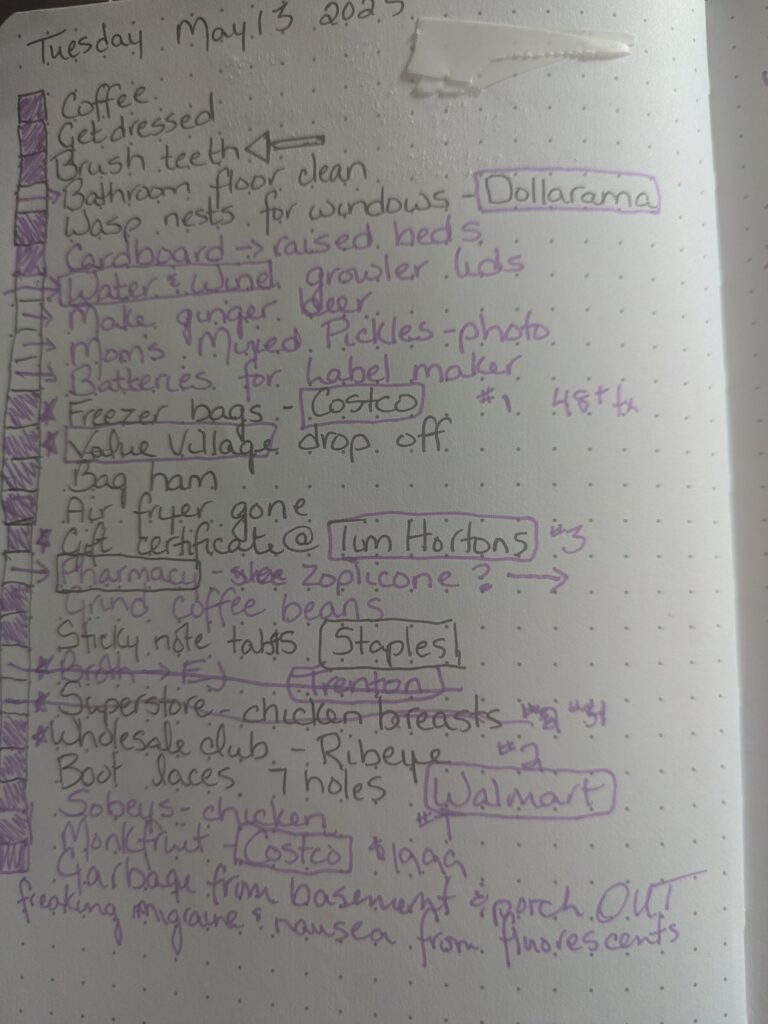
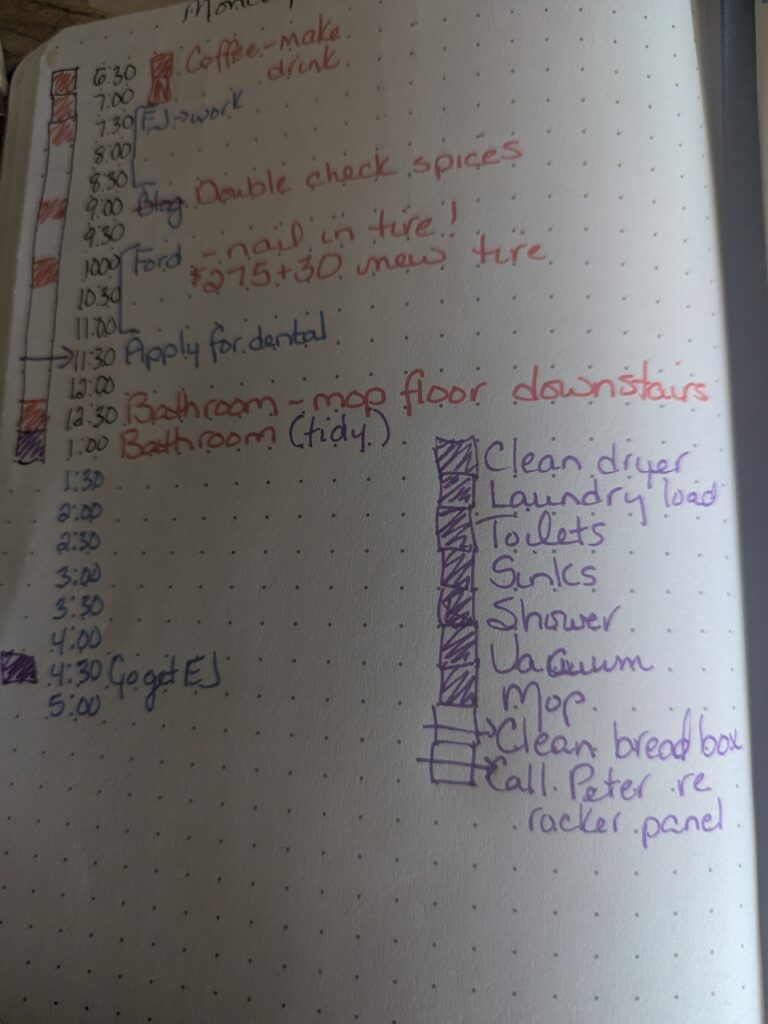
Let’s tear this apart. Yes, it’s messy. Filled-in means I did it. An arrow means I’ve rescheduled it. A line through means that I decided against doing it at all. Both still tell my brain that I did a thing! There’s a box around stores so that I can see at a glance where I need to go. And a lot of those things were written after I did them.

The Dopamine Hack? Write it Down. Check it Off. Get the Boost.

Your brain craves reward signals, but it often fails to give them for routine tasks. Writing something down and checking it off (or colouring in a box) forces a small but tangible dopamine hit—tricking your brain into feeling accomplished, even for simple things like “Get dressed” or “Make coffee”.

That tiny reward loop makes it easier to engage, focus, and build momentum.

Can you see how messy this gets? How I decided to go through my spices instead of work on the blog? And how “tidy bathroom” turned into actually cleaning the room?

Why This Works (Even If It Feels Silly)

✔ Your brain loves patterns and systems—tracking tasks helps create a structure, making it easier to remember things naturally.

✔ When you physically check something off, it reinforces the habit, improving task memory and motivation.

✔ Even micro-wins (like ticking off “Sit up in bed”) provide dopamine fuel, helping you move toward bigger goals.

It’s not cheating, even if you’ll feel like it is at first—it’s brain hacking.

When motivation is unreliable, small intentional dopamine boosts help bridge the gap between “I need to do this” and “I actually did it.”

💡 Pro tip: If you didn’t write it down before hand, you can to write it after you do the thing, even the next day. Instant dopamine boost, no shame required.

My New Imperfect System: The Daily Spark

I didn’t come up with this. My friend Elizabeth told me to grab a notebook and write down “Make coffee” and “Drink coffee” while I was drinking my morning coffee.

I laughed—how could that possibly work?

And yet, all day, she kept nudging me: “Did you write that down?” And we DID things!

Now it’s what we say at my house all the time. Did you write that down?

I’ve modified it since, taking some stuff from bullet journalling. And by the way, I love the idea of bullet journalling – I just know I won’t do it. Here’s what makes the Daily Spark different:

  • The day is broken down by hour—but only when I need it. Why bother scheduling when I don’t need it?
  • I write things down after I do them. Feels weird, sure, but it’s key to making this work.
  • If I don’t use it for a few days? No shame. Turn the page and start where I am.
  • Blank space is not failure. It’s breathing room.

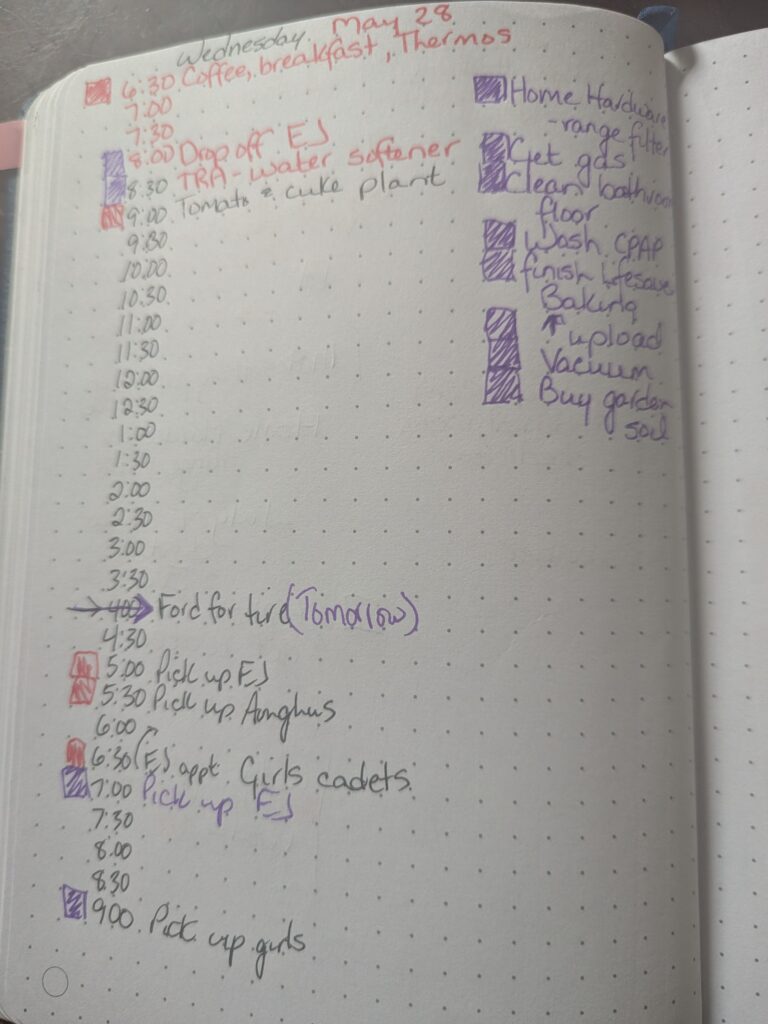
Here’s a day with a lot of time-specific events. I tried putting the tasks on a second page except … I apparently don’t see them when I do that. So, I squish them in, and it still works. And that big space where I have nothing? It’s because I knew I’d be on the move from 3:30 until 9:30 and if I didn’t have serious downtime during the day, I’d have had a meltdown.

Want to Try It?

I made a printable that matches what I use, but it’s not necessary. I’m not selling you anything here. A $1 scribbler from the dollar store is perfect for this – it’s flexible, disposable, and doesn’t come with any guilt.

The magic isn’t in fancy layouts or pre-printed boxes. It’s in the act of writing, colouring, and reinforcing tiny wins.

  • Woke up.
  • Didn’t die.
  • Snuggled the cat.
  • Got out of bed.
  • Made coffee.

You’re not broken. You just need a system that sparks with your brain.

Download the Daily Spark Printable Here

You’ve got this.

Filed Under: Sustainable Home

Primary Sidebar

Latest news

  • 10 Foods to Boost Vitamin K
  • So You Just Got a Goat! Essential Goat Care Tips
  • The Low FODMAP Way to a Healthy Gut

The Mission

Just Plain Living cuts the crap and gets real about neurodivergence, executive dysfunction, and parenting chaos. No fluff—just honest, practical life hacks for messy, beautiful living.

Recent Posts

  • 10 Foods to Boost Vitamin K
  • So You Just Got a Goat! Essential Goat Care Tips
  • The Low FODMAP Way to a Healthy Gut
  • 5 Lesser Known Superfoods You Should Try
  • Benefits of Elderberry: Why You Need this Superfood

Recent Comments

No comments to show.

Recent Posts

  • 10 Foods to Boost Vitamin K
  • So You Just Got a Goat! Essential Goat Care Tips
  • The Low FODMAP Way to a Healthy Gut

Copyright © 2026 · Niche Theme

Copyright © 2026 Marie Campbell Beausoleil