• Skip to primary navigation
  • Skip to main content
  • Skip to primary sidebar

Just Plain Living

building a life that bends without breaking

  • About
  • Blog Posts

Survive and Adapt

5 Low-Energy Ways I Cope With Mild Depression

August 24, 2025 by marie Leave a Comment

This post was published on JustPlainCooking.ca

Mild depression doesn’t always look like what you see in movies. Sometimes it’s just lying in bed too long, forgetting to eat, or staring blankly at a to-do list you know you should care about — but don’t. These are five low-energy, practical ways I deal with mild depression when even brushing my teeth feels like too much.

This post is not medical advice. I’m not a therapist, psychologist, psychiatrist, or anything with a -ist. I’m just a neurodivergent woman with four kids at home, executive dysfunction, and a brain that occasionally decides to unplug itself and lie down in a dark room. Oh, and an inoperable brain tumour – I suppose that doesn’t help, hm?

Sometimes life is awful. Sometimes life is fine, but my brain tells me it’s awful anyway. That’s what I call “mild depression.” It’s not the kind that puts me in crisis, but it absolutely steals days from me.

These are the five things I do to keep going — not thrive, not glow up, just keep going. And some days, that’s enough.

I Get Vertical

Lying in bed all day makes it worse. But sitting up in bed? That’s a win. Standing in the kitchen staring at the wall while the kettle boils? Victory.

Sometimes I don’t shower. I don’t clean. But I do move from horizontal to vertical. And that, in this house, counts as progress.

Bonus – if you can do some cleaning, enough to prevent a pile up, Future You will be grateful.

I Do One Stupid Easy Thing

Usually, it’s “make coffee” (or carbonated water or whatever I know I’ll be doing anyway).

And I write it down after I do it, just so I can cross it off.

Seriously.
I’ll literally write:
☐ Make coffee
✅ Make coffee

Why does that work? Who knows. Magic executive dysfunction witchcraft – I’m sure there’s a psychiatrist out there who can explain. But it helps my brain say, “Hey, we did a thing today.” Weirdly, that’s often enough to get the dopamine.

I Move the Air

I don’t go for a walk. I don’t do yoga. I don’t “get fresh air” like Pinterest says.

I move the air around me.

Sometimes I open a window.

Sometimes I turn on a fan.

Sometimes I just flap my arms like a depressed duck.

It resets something. Again, I have no clue why. But it works.

After that, if I feel up to getting my butt outdoors to look at the sky and get some vitamin D, awesome. Because yes, we’re basically houseplants with anxiety and we do need the sun.

I Pet the Cats / Feed the Kids

Feeding another living thing — even if it’s just tossing kibble into a bowl or reminding Eve that toast exists — reminds me I still exist too. That I still matter, even if my brain is yelling otherwise.

Pets, plants, kids, sourdough starters — they keep you grounded. They don’t care if you brushed your hair. They just want you there.

I Find Something to Laugh At (Even If It’s Dark)

Dark humour is a coping skill. (Fight me.)

I’ll scroll memes. I’ll watch weird animal videos. I’ll read one of my own snarky posts and remember that I am still funny, even if I feel like a sentient bathmat.

Laughter isn’t a cure, but it’s a tiny light. Even if it’s just for a minute.

If you’re dealing with mild depression — or the kind of neurodivergent shutdown that looks like it — I see you.

You’re not lazy.

You’re not broken.

You’re a person doing your best with a fried brain and a world that never stops asking for more.

None of this is medical advice. But it is lived experience.

And maybe — just maybe — it’ll help you get through today.

Where to Get Real Help If You Need It

If the fog isn’t lifting or things feel heavier than just “a bad day,” please don’t try to carry it alone. These aren’t affiliate links or sponsored — just good places to start when you need a hand, not a hashtag.

🇨🇦 For Canadians:

  • Talk Suicide Canada (24/7): or call 1-833-456-4566
  • Wellness Together Canada: free mental health resources and live counselling
  • CMHA (Canadian Mental Health Association): local support and programs

🌎 For Anyone, Anywhere:

  • 7 Cups: free, anonymous chat with trained listeners. Not therapy, but helpful when you just need someone awake at 3am.
  • The Mighty – Mental Health: relatable articles by folks who’ve been there
  • You Feel Like Sh*t: An Interactive Self-Care Guide: cheeky, kind, and sometimes exactly what you need
  • The Nap Ministry (Instagram): because rest is resistance, especially when capitalism is telling you to “do more”
Filed Under: Survive and Adapt

Pet Disaster Plan and Bug Out Bag

August 18, 2025 by marie Leave a Comment

First Published on JustPlainMarie.ca on Aug 18, 2016 and JustPlainCooking.ca on 2019-02-13

Disaster planning for pets is often hard to find, but cats and dogs are just as important in the family as the two-legged members, especially service animals.

It is with pleasure that I share this incredibly comprehensive Pet Disaster Plan with you. This guest post was written by a former dog trainer who wants to make sure that all of my readers keep their precious animals safe no matter what happens.

Pets are such a very important part of our lives for so many people. Just like preparing to keep the people safe during a disaster, we need to assemble supplies, gather information ahead of time and know what to expect.

PRE-PLANNING

Before an emergency occurs, contact your county’s Emergency Management office to find out all of the emergency pet-friendly shelters in your area and what requirements there are for bringing your pets.  Ask what kinds of animals are allowed as many shelters do not allow reptiles, insects and exotic pets.

Also call local shelters and ask if they provide emergency or foster care during a disaster.

You want to have as many different places as you can because if an emergency occurs in the area you have decided you would go to…well, you just can’t go there! If you already have other places it is much easier than trying to find another place during a disaster.

Keep the list and a pre-marked map in the go kit.  By pre-marked I mean that you should locate each address on the map, use a different color pen or marker for each address and circle the address in that color.   On the list of addresses, make a mark with that color or write the phone number in that color of ink. You will be ready to head in a different direction and not be too flustered.

Many shelters for pets require that you pre-register before a disaster. You must check with your local shelter. Registration is important because it lets the county how many animals, and what types, will be looking for shelter.

If you have a Service Dog, it will go to any shelter you go to. Any other pets may have to be taken care of by a friend or family member.

Pets in a shelter must be taken care of by someone. Shelter staff are not there to look after, feed, medicate or clean up after your animals. Remember that people and animals are almost always housed separately. You cannot stay with them all the time but you or a family member must check on them often.

People who have special needs must register for a special needs shelter.  Only you, a caretaker and, if you have one, your service dog will be allowed in the special needs shelter.  All other family and pets will go to another shelter.

But now that you’ve figured out where you could go, how do you ensure you can get your pet safely there – and provide care while you weather the problem? Keep reading to get a detailed list of supplies that you should have on hand.

GATHERING SUPPLIES

This is also done in the pre-planning stage.

People aren’t the only ones who need Bug Out Bags. Each animal needs one, too.

If you have animals, paperwork must be properly done and updated each year (or whenever relevant). You don’t want to discover that the paperwork is out of date during an emergency.

Current vaccination record

Be sure that this includes a health certificate, if this is necessary in your country. In the US, this is a requirement to take an animal across state lines.

On the vaccination record, write in the rabies tag number and county, if it isn’t there.  Also write in the number and type of microchip.

Make two copies of each pet’s paperwork. For each pet, add a copy of a photo of you and your family (or an authorized friend) with that pet.  You need two copies of the photo.

Fill out the species card, for each pet.

Also, write down medications and what health issues they are for as well as the medication times.  This can easily be forgotten under stress.

Write down feeding amounts and times as well.

One copy of each piece of  paperwork and photo of your pet will go into a Ziploc bag and be attached to cardboard by tape.  Poke a hole through the Ziploc and cardboard, in the corner, and put a zip tie through the hole. This will attach to that pet’s crate.

One copy of each piece of paperwork and photo stapled to it will go in a folder you keep in your go bag.

Do this for each pet.  Be sure the photos are clear and can be used for identification of you and your pet.  Things happen in disasters and people/pets can be separated, even if in the same shelter!  Better safe than, well…you know.

Collar

Buy each pet that wears a collar an ID tag with your name, cell phone number, the number of an out of state/province relative or friend and your pet’s microchip # on it.

Make sure it is a friend or relative that would take care of your pets should something happen to you.

Food

Food for one week.  If your pet is on specialized food, plan for a minimum of three weeks.

After a disaster it may be difficult to get specialized food.

If you can, put the meals into ziplock bags.  Give just a bit less per meal as bathroom times can be limited. If you feed canned food, be sure to include a manual can opener (one for each pet that requires canned food).  Even cans with pop up tabs may need a can opener now and then.

Water

Water for one (1) week.  Ask your veterinarian how much water each pet needs daily.  Since it is easy to fill a water bowl whenever we want most of the time it is hard to judge what amount is right for dog sizes from chihuahua to great danes.

Food and water bowl

Each pet needs its own food and water bowl so you can monitor its eating and drinking.  Under stress many animals will stop eating and drinking.  The non eating isn’t a problem except for those with health problems normally…but not drinking can cause issues.

Treats

Treats can stimulate lost appetites but do not give very many as they can cause tummy aches.

Gas and diarrhea meds

Speaking of tummy aches…in each go kit you should have “gas” pills (such as Phazyme or generic equivalent) and diarrhea pills (such as Imodium or generic equivalent). These are very important and should be considered “must haves”.

Quiet toys

Quiet toys (i.e. Kongs with peanut butter or squirt cheese; antlers or bones; hard rubber toys). Do not include anything with squeakers, bells, or other noise makers.  If your dog tears up a toy be sure to pick up all of the pieces.  There won’t be a way to get them to a veterinarian if they swallow a piece of a toy.

Bedding

Blankets or bedding.  Towels are also great.  Something soft that can be changed if needed.

Crate

One crate per animal, large enough for them to turn around in, stand up and stretch out to sleep.  A cat will need room enough for a litter box…disposals or aluminum  turkey roasting pans.  Don’t forget the litter and the scooper!  (BTW, cat toys should be quiet as well).

IF your animals are used to being crated together, they can be kept in the same crate but be aware there is a possibility tensions that are running high can cause fights.  Think of the back seat of a car with kids that normally are fine together…but on a five minute ride in the car want to kill one another.

Extra harness/collar

An extra harness or collar in case something happens…such as a chewing “accident”.  Don’t forget to change the id and rabies tags over.

Leash

Extra leashes are also a good idea.

Muzzle

Each pet needs a muzzle, fitted for it, just in case.  Scared animals will sometimes bite…even the owner.

Medication and Instructions

All medications should be labeled with pet’s name; medication schedule and instructions on when and how to give them should be on the species card.  The medication should be kept with the person in charge of the animal.  Never leave it unattended.

If you use pill pockets, peanut butter or squirt cheese to give the medication be sure to have enough of these to last two (2) weeks for each pet.

Portable Potty Spots

If you have dogs that dislike wet feet, during flood or hurricane disasters you can get plastic tablecloths at the dollar store.  Depending on your dog’s size you can cut these up for “portable potty” spots.  You need several such pads.  After use, bag them up in plastic bags that can be sealed by tying or other means.

Keep reading for the printable supply list!

Cleaning Supplies

Paper towels, wet wipes or Clorox wipes or cleaning solution; Trash bags…garbage as well as potty bags; antiseptic gel for your hands.  Disposable diapers, cut up, are wonderful for “wet” stuff. Put the plastic side up, filling side on the wet and step on it.

Be kind to the other people and pets in the shelter.  Clean up whenever your pet (s) go to the bathroom! Grocery bags (check there are no holes) can be used to put the mess into…then put inside a larger garbage bag to keep the smells down.

Small Pet Supplies

Small pets (gerbils, guinea pigs, etc.)will need food/water/meds/toys and wood chips or other cage lining.

Bird Supplies

Birds will need their normal items.

First Aid Book

Have a first aid book for each type of animal you have.  First aid supplies will be listed in the books.

Hunger and Thirst

A good rule of thumb…if you are hungry or thirsty, chances are your pet (s) are as well. Unless you are a stress eater…

Keep your animal Bug Out Bags in the same location as the people’s bags.  Load your car with kits first, crates second, pets third, humans last.

Unload in the opposite direction – humans, pets, crates, kits.

Don’t overlook these very important aspects of preparation. A supply list will do you no good if you have a terrified animal in full panic mode.

Crating

If your pets are not used to crating:

Begin now!

With crate door open, throw in a toy or treat while they watch.  Don’t say anything. Let them explore.

Do NOT close the door! After a week or two of doing this a few times a day, add some bedding, leaving the door open.  Continue to throw a toy or treat in.

Do not close the door until your animal is totally comfortable.  Give them a long lasting toy (treat filled Kong or bone) and close the door.

Open the door when they are finished with the treat.  Slowly creep up the time the door is kept closed.

Travel Preparation

If your pet is not used to traveling anywhere other than the vet’s office, you can get them used to that, too.

Short trips at first.  Please contain your animal(s) or put them in animal seat belts for their safety and yours.

If they don’t mind a short ride and do not get car sickness, add a few minutes to the trip each time.  Always follow a travel session with a special treat, lots of praise and a happy, happy voice!

And now you’re prepared for a disaster with your pets and service animals.The only thing you’re missing is a First Aid Kit for Pets so go get it!

Filed Under: Survive and Adapt

9 Ways to Boost Your Immune System (So You Can Do The Things!)

August 18, 2025 by marie Leave a Comment

Published on JustPlainCooking.ca December 6, 2019

Your immune system is vital to how your body functions. It is easier to take care of it now than to repair it after your immune system has failed. Here are some surefire ways to boost your immune system.

We talk an awful lot about our immune systems. Or maybe that’s just me?

I know that immune system health and natural immunity are topics that come up all the time around here.

Over the past couple of years, I’ve half-jokingly asked if anyone knew where I could buy a new one. I seemed to have misplaced mine because I was always sick and exhausted. It’s time to really start looking into how to boost immune system strength because without it, you can do The Things!

Ways to Boost Immune System Health

The immune system is a collection of special cells, organs, and substances that defends the body against infection and illness. It monitors the body at the cellular level and attempts to rid it of anything unfamiliar.

It’s …. important. I know, that sounded all geeky and weird, but the simple language is – your immune system is  your body’s defense system against germs and infection.

The most commonly known immune deficiency is, of course, AIDS.

Acquired Immune Deficiency Syndrome.

But you can certainly have a compromised immune system without having AIDS. Allergies are an example of an immune system running amuck. Like a terrified dog attacking friend and foe, the immune system can’t tell the difference between a virus and a peanut. Considering that allergies can be fatal, imagine how very powerful a healthy immune system is.

Antigens and Our Immune System

Any substance that enters the body that the immune system does not recognize is known as an antigen. When an antigen enters our bodies, the immune response is triggered and the attack to get rid of it begins.

Our immune system, when healthy and working properly, has the ability to destroy anything containing a particular antigen, including, germs, viruses, and cancer cells.

It’s safe to say that without our immunity, we wouldn’t be around too long because our immune system is a tireless warrior protecting our health. There are bacteria and viruses everywhere, not to mention helminths (worms) and tiny mites that carry infection and our immune systems continuously fight all types of bacteria, viruses and various parasites.

We also use our immunity to fight and kill cancerous cells that can pop up in our systems. Clearly it’s not always successful – just like we get flu, colds, worms and other infections, we also get cancer. People with a poor immune system get cancer at higher rates than those whose immune system is working properly.

It is therefore of great importance to be sure and take care of our immune system health. Thankfully, some of the ways in which we can do this are also beneficial in other ways to our overall health.

What are some ways we can maximize the effectiveness of our immune system to stay as healthy as possible? The biggest problem I have found, when your immune system has taken a beating, is that you’re too sick and tired to get up and figure out how to fix the problem.

Choose Foods to Boost Immune System

This means getting enough nutrition through fruits and vegetables, and nuts and seeds. There are nutrients in these foods that act as antioxidants, scavenging your body for oxygen free radicals that can damage cellular systems. Research has shown that increasing the number of fruits and vegetables in your diet can improve the ability of immunizations to “take hold.”

When you’re feeling exhausted, and catching ‘every bug that goes around’, it can seem extremely difficult to make healthy meals. I have been there, groaning at the thought of even preparing pre-frozen meals. You KNOW you need to eat healthier if you want to feel better, but every thing you do is just a tremendous effort.

If that’s the situation you are in, please enlist help and find ways to get your fridge and freezer stocked with meals that are both healthy and super easy. Powdered greens, which can be added to water, both hot and cold drinks, and even mixed into food, are a super efficient way to boost your veggie intake, and it’s one of the methods I used to get my family back on our feed again.

There ARE others, though, and you may find locally-sourced powdered greens at your Farmer’s Market. Supporting your Farmer’s Market is a great way to eat local and seasonal food.

[adthrive-in-post-video-player video-id=”42wyIcd6″ upload-date=”2019-03-30T15:35:01.000Z” name=”9 ways improve immune system” description=”null”]

Stay away from tobacco smoke

Tobacco smoke ruins immunity, even if you aren’t the actual smoker.

Hopefully by now most of us are becoming aware of the health problems caused by living in a house or driving in a car where people smoke.

Children have an increased risk of getting middle ear infections and lung infections when exposed to second hand smoke by way of parents or family members smoking around them. Cigarette smoke in the household, and on the clothes of adults in the house, greatly increase the risk of SIDS. Adults are more prone to getting bronchitis and pneumonia when exposed to tobacco smoke.

The toxic ingredients in smoke lessen your ability to fight off all kinds of infections.

Cut down on alcohol

Those who excessively drink alcohol have an increased risk of getting infections from a poor immune system. Pulmonary infections are particularly likely to happen in heavy drinkers.

That doesn’t mean that it’s unhealthy to have a drink every once in a while. Just keep it in moderation. If you’re drinking every day, or finishing bottles all by yourself, you might want to look into that.

Eat probiotics

Most people now know what probiotics are.

If you’re one of those who hasn’t discovered them yet, probiotics are one of the best things to reach mainstream medicine. They’re found in some yogurts and in lacto-fermented foods and they can be purchased in capsule form.

Probiotics consist of living spores of healthy bacteria or living organisms themselves. They colonize the gut and displace the “bad bacteria” that can make you sick. With probiotics, you can have a healthier gut immune system and can avoid gastrointestinal upset from bacteria or fungi in the gut.

If you’re dealing with a compromised immune system, fermented foods containing probiotics should be part of your daily diet. Start your day with a dish of yogurt. Add a tablespoon of homemade kimchi or sauerkraut to your dinner plate.

Garlic is an antimicrobial agent in and of itself. It boosts the immune system in a general way but is inactivated by heat. This means you’re not getting the benefit when you cook with it.

To get the health boost, add garlic last to your meal just before serving.

Get vitamin D

Many people in the Northern Hemisphere are deficient in vitamin D and this can negatively affect immunity, particularly in the winter months.

You can get vitamin D with exposure to the sun or you can take a vitamin D supplement. As some people need a lot of vitamin D and others don’t need as much, have your vitamin D level checked periodically until you find a dosage of vitamin D that brings your level into the normal range.

In the summertime, just ten to fifteen minutes of sunlight per day can be a big benefit to your immune system.

Eat shitake and Maitake mushrooms

Studies have shown that really concentrated extracts of these types of medicinal mushrooms have enhanced the immune system of women who have breast cancer. While eating the mushroom alone hasn’t been studied, it may have a beneficial effect on the immune system of otherwise healthy people. Another that people are talking about is Chaga mushroom – which looks less like a mushroom and more like a piece of burnt wood attached to a tree.

If you don’t have any medical reasons to avoid mushrooms (like a serious fungal allergy), it is worthwhile to add them to your diet.

Immune Supporting Herbs

There are tons of immune-supportive herbs out there and probably yet to be developed.

Some important ones are eleuthero, Asian ginseng, astragalus, and American ginseng. These have been used in Chinese medicine for millennia to prevent infection and keep the body healthy. They can be found at health food stores everywhere and even at certain pharmacies. Do your research before adding these to your health care, and do speak to a medical professional.

Echinacea tincture

Echinacea is good for respiratory infections, especially when taken early in the course of the infection. Make a tincture yourself or get one from a reputable herbalist.

The important thing to remember about Echinacea is that you don’t take it all the time. Have it on hand so that you can dose up the minute you can feel an infection starting, but don’t continue taking it after you’re feeling better.

And here’s a bonus tip that I added after I created the graphics!

Detox Your Environment

Still struggling with health and immunity issues? Still wondering where your immune system went?

Recently, I went through my entire house with the help of a good friend. I was sick and tired of being sick and tired. The funny thing is that I thought my household cleaners were generally safe. I grew up with Mr. Clean and these ‘ordinary’ cleaners, after all. And shampoo? I mean, it’s just shampoo, right?

They’re not TOXIC, they’re just … well, yes, they’re pretty toxic when you’re dealing with a weak immune system.

Over the course of a week, we replaced my soap and shampoo with an unscented African Black Soap (which I’m loving). I use it for my hair, face and body.

We tossed out window cleaners, floor cleaners and even dish soap and mixed up bottles of cleaners using castille soap.

The harsh Cascade dishwasher detergent was replaced with a natural brand using organic ingredients – suddenly I can be in the kitchen when the dishwasher is running and I don’t feel like an elephant is sitting on my chest.

Tide Free replaced the scented laundry soap, and I just found a local seller of soap nuts, so that’s next.

After a week, I’m noticing smells that I hadn’t been aware of before and I have more energy than I have had in the past several years.

A year ago, I wondered if I would ever get my immune system working well again.

Since then I’ve learned to decrease the constant but unnecessary assaults on it, improve my diet and take a few simple steps strengthen my immunity. Now my joke is that I’m aging backwards – and it feels great! If you’ve been wondering how to boost your immune system, rest assured that the answer is not difficult or complicated, but it’s definitely worth the effort!

Filed Under: Survive and Adapt

Short Term Survival Food Storage

August 18, 2025 by marie Leave a Comment

First published on JustPlainCooking.ca Sep 13, 2021

When you are sheltering in place, are planning on staying in a shelter, or even dealing with the possibility of being stuck out on the road, having food and water is your top priority in any disaster situation. You can make it without power, and a lot of creature comforts, but you can’t survive without food and water.

Emergency food storage doesn’t have to be complicated or expensive.

In fact, it can be mainly comprised of items your family is already eating.

Before you go out and start buying all the water, bread, and milk you can get your hands on, figure out how long you want to prepare for.

Having at least a week’s worth of food and water stored up can be a great idea during a natural disaster. Keep in mind that you not only have to ride out the storm itself, but that it may also take extra time before help and supplies can make it to you.

Water

Start with your water supply.

Hopefully you will continue to have running water, but don’t depend on it as your only source of drinking water. We have our own well, a good one that has never gone dry, but we always keep water stored.

Buy water bottles, or fill up milk jugs, soda bottles and the like to ensure you have enough clean water to safely drink for a few days. You can make it much longer without food than without water. This should be your number one priority.

Non-perishable food

Next think about non-perishable food that your family will eat.

And oh, yes, always keep in mind ‘food that your family will eat’. I have cricket powder stored in my pantry but it’s not likely to be used in an every day disaster.

Choose food that you can eat as is.

Crackers and peanut butter are a good choice, as are canned beans, soups, and similar.

Canned tuna or chicken makes for a great protein source. Bread is another good option along with your favorite non-perishable sandwich toppings. Don’t forget about things like granola bars, protein bars, nuts, or beef jerky that you can eat right from the package.

If you have a camping stove, or a grill outside, you may also be able to heat and cook some foods. Instant oatmeal, coffee, hot chocolate mix, soups, and even instant rice are great options if you have the ability to heat water when the power goes out.

Last but not least, stock up on some favorite treats like chocolate, chips, pretzels, cookies, and others that keep well. It will make getting through those tough disaster days a little more bearable.

Start with a list of things that you know your family will eat and things you’ll use up even when you don’t need them during a disaster.

From there, start to round it out with things that will keep you full and healthy and pick those up as needed. For example, you may eat canned vegetable or chicken noodle soup regularly, but aren’t a big fan of tuna (although you’ll eat it if the power’s out and you’re hungry).

Keep a small supply of the soups in your pantry at all times (rotating through them as needed), and pick up a few cans of tuna as needed.

Talk to your family about your survival food supply and let them have input into what you should stock and keep as well. It will give them a sense of control and responsibility and of course ensure that everyone is happy with the meals available when things get serious.

Filed Under: Survive and Adapt

You’re Not Too Poor to Prep

August 18, 2025 by marie Leave a Comment

Originally published on JustPlainMarie.ca on July 20, 2016 and then on JustPlainCooking.ca

You can certainly start prepping for trouble and disasters if money is tight!

You Can Afford to NOT Prepare

In fact, you really can’t afford not to – even if you’re on welfare and visiting the food bank regularly, you’re not too poor to prep.

Do you really believe you’re too poor to prepare for disasters?

If you ask people if they would like to survive in a disaster situation, every one of them would tell you yes, obviously. (And by disaster, I mean anything from job loss to devastating hurricane!)

But if you ask them how many of them are actually prepared, you’d see maybe only a third of them (and that’s being generous) would say they were.

While everyone wants to survive a natural disaster or economic collapse, not everyone will actually work a plan to make sure that happens.

There are always a variety of reasons that people give for not preparing.

Topping the list is always the excuse that putting a survival plan in action costs too much money.

And at the back of this excuse is the belief that the government will always pick up the slack during an emergency.

After all, isn’t that what the government is there for?

What they fail to realize is that most governments aren’t in the position to help people during a catastrophic event. Sure, the government can step in and help if an area or two is hard hit – but we saw how well that went in the United States during Hurricane Katrina (and Maria and Harvey!) and other disasters.

Before 2020

I’m editing this post in 2025, and I have to sigh at what I wrote in 2015 when I wrote this. So much has changed in ten years. However, I’m not changing the next few paragraphs.

Now imagine a disaster of such proportions that it astounds the entire world. If something like an Ebola crisis began to hit hundreds of thousands of people in every city, for example.

I recently read a post-apocalyptic series in which humanity was almost destroyed by a fungus that took years to manifest fully. By the time it became apparent that the fungus was deadly, it had infected the world. Even on a lesser scale, any virus that doesn’t manifest quickly has the ability to travel far and wide.

Governments wouldn’t be able to keep up. If you weren’t infected and had to stay quarantined in place, you would become one of millions. How well do you think your needs would be met?

And Back to 2025

So now we don’t need to imagine. We know how quickly a virus will travel the world. We know how helpless governments everywhere will be. And we know that, in the end, we are on our own, relying on the preparations we’ve put in place before the crisis.

You can’t afford to rely on anyone else and you can’t afford not to prepare.

The problem that most people have when they use the excuse that they can’t afford to gear up for survival is that their outlook is far too broad.

They’re looking at a list of supplies as a whole rather than breaking them down and concentrating on building up in small increments. Or worse, they think preparedness means a bunker full of bacon or more toilet paper than they’ll use in a lifetime. (Never, ever, ever will I understand the run on toilet paper.)

You can set aside the supplies you need for survival even if you don’t have all of the money you need at once because you can do it on a budget.

Four Simple Things You Can Do

Even if you live paycheck to paycheck, you can afford to prepare. Buy just a little extra each month. And I mean a little – if your “extra” is $10, that’s what it is. It’s better than $0! As each month passes, your store of supplies will grow.

Concentrate on reaching small goals first.

Build Community

I know, I know. I said you can’t really rely on anyone else, and that’s true. But the myth of the lone wolf living in the deep woods and never speaking to anyone else – it’s a myth. People need people.

Two incidents here in Nova Scotia made me realize how much we all need community – Hurricane Fiona in 2022 and then the incredible snowstorm in early February 2022 that dropped over five feet of snow in a weekend. From food to emergency lodgings to damage repairs, people relied on each other and we all got through both.

Get a good cookbook

Yes, this is a shameless plug for my cookbook, but if you read the reviews on Amazon, you’ll understand why. A Cabin Full of Food is designed to keep your pantry full of home-grown food and your table full of delicious meals made from that food. The recipes will work equally well in a fully equipped modern home and in a grid-down situation.

Even if you have no idea how to cook, the simple recipes in conversational format, will help you put food on the table. So your first step is to get A Cabin Full of Food – and then start using it. None of the ingredients are “exotic”, expensive or difficult to find, and the cookbook is in use from South Africa to France and all through North America.

Double Up

Let’s say you are planning to make a recipe using canned corn (and you haven’t yet canned your own) because you noticed that canned corn is on sale – Buy one, get one free.

Instead of buying the three cans that you planned to use this week, pick up six. You’re not spending any extra money.

Later, as you have more ready cash and are more comfortable with stockpiling, you might buy a case or three during the sale (which is what I usually do), but even if you buy three extra cans, you have painlessly added to your pantry.

Focus on Small Goals

You do not need to run out and buy a year’s worth of food for every member of your family. Start working on building your deep pantry. When we started prepping, we were poor enough that we qualified for food bank assistance and other help.

Building a deep pantry was one tool we used to pull ourselves out of that poverty.

The same thinking applies to other supplies. Watch for sales. Have a list and slowly pick away at it. Focus on small goals and celebrate your successes.

Someday you’re going to find that you’re researching how to build a chicken coop, the basics of goat care, and taking steps to full time homesteading, and you’ll look back and realize that you got there by starting when you were “too poor”.

It happened to us.

Filed Under: Survive and Adapt

Are You Any Good?

August 17, 2025 by marie Leave a Comment

First published as a musing on CanadianDoomer.ca in 2012, but it’s even more true now, in a world that seems determined to keep us guessing about what’s next.

Let’s get something out of the way: Most of us don’t actually know how capable we are. We don’t get a report card for “surviving upheaval,” or a diploma for “navigating total chaos with only a spatula and two feet of duct tape.” No one hands you a medal for keeping your family fed when the pantry’s looking bare and the next grocery run is a week away.

I was reminded of this the other night, of all places, while reading a Barbara Hambly novel (Sisters of the Raven – highly recommended for anyone who likes their fantasy with a side of desert survival).

One character asks, “Are you any good?” Not at school or work or the easy stuff, but at staying alive when everything’s hard – climbing trees, dodging danger, keeping hope alive.

The answer:

“I don’t think she knows how good she is, any more than any of us do, until we have to find it out.”

It hit me like a brick. Because here’s the secret: most of us, especially those who’ve grown up with grocery stores, hot water, and phones that tell you the weather, have no idea what we’re capable of until we’re up against it.

You Learn By Living

If I’d understood how much work it actually takes to put up a year’s worth of food – shelves of home-canned tomatoes, enough potatoes to get through to May, and something other than jam for variety – I’d never have tried. Honestly, I would have quit before I started, just from the overwhelm.

And yet, every year, I get a little better.

  • The first year, I didn’t put up fruit. Who needs vitamin C, right?
  • The next, we ran out of root vegetables long before the last frost.
  • Some years, it was forgetting to label, so we played “mystery dinner” with the jars.
  • I’ve burned out the clutch on more than one manual kitchen tool and learned the hard way that a pressure canner is not a slow-cooker.

But here’s the thing: Each time, I failed better.

Capability Isn’t Comfort

The story we tell ourselves, the story the world tells us, is that if we were really good at something, it wouldn’t feel this hard. That the truly capable never doubt, never get tired, never make a hash of things and cry in the pantry.

That’s a lie.

If you’ve ever stood in your kitchen, exhausted, kids hollering, wondering if you can actually do this – keep going. You’re already doing it. You don’t know how good you are because the test is still running.

Most of us are shockingly capable when we have to be.

Not just at surviving, but at adapting, learning, even thriving.

That’s why I do things the old, hard way, sometimes – using manual tools, eating from the garden, figuring it out with what’s on hand. Not to be a martyr, but to find out where my edges are. Because I’d rather fail while learning than be blindsided later.

You’re Stronger Than You Think

If you’d asked me before I became a mother if I could handle childbirth (or, let’s be honest, raising a toddler while sleep-deprived and running a household), I would have said: absolutely not. And yet, like every mother before me, I did it. Heck, I did it six times! Not because I was ready, but because I had to.

So here’s my gentle nudge, for you and for myself: You don’t know what you’re capable of until you’re in it. The only way to find out is to keep going, one messy, imperfect, deeply human step at a time.

If you’re facing something hard, whether it’s learning to live with less, building new habits, or just figuring out who you are now, remember:

You’re already more capable than you realize.

The only way to know how good you are is to keep living.

And every “mistake” you make is proof that you’re in the arena, getting better as you go.

You might not feel like a survival expert, a household manager, or a builder of resilient lives. But you’re here, you’re still trying, and that’s more than good enough.

Build a life that bends but never breaks. You’re stronger than you think.

Filed Under: Survive and Adapt

That Time We Accidentally Poisoned Ourselves With Carbon Monoxide

August 17, 2025 by marie Leave a Comment

Every so often, I trip over something in my old blog drafts that’s so real and unvarnished, I can’t help but dust it off and update it. This one’s from November 2012 on my very old CanadianDoomer.ca and then republished in 2015 on JustPlainMarie.ca – back when Rina was a brand-new baby, I was still healing from childbirth, and our life was a circus act involving a newborn, a slum apartment in the city, and the looming prospect of moving off-grid.

Babies, Burnout, and the Big Cabin Experiment

Rina was at that magical stage – just under three weeks old, and already worrying a small army of midwives, doctors, and (because life is never simple) the occasional social worker. See, every one of my six kids lost a lot of weight right after birth, then struggled to regain it.

They’re all healthy now but let me tell you: In those first days, every feed feels like a life-or-death negotiation. You don’t relax until the baby regains their birth weight – that’s the “deadline.” After that, you’re allowed (by law of new-parent exhaustion) to maybe sleep for longer than forty-five minutes at a stretch. Aonghus, in fact, currently 5’10” at 18, and with two hollow legs, spent four days in the hospital because he missed that deadline.

At the same time, we were wrangling with our city apartment – a place so lively the mice and ants had sublets, and the police made regular appearances because it was “that sort” of building. And, as if that wasn’t enough, we were knee-deep in paperwork and packing for our grand experiment: moving to an 800-square-foot, hunting-cabin-turned-home deep in the Nova Scotia woods. We moved the following April.

Spoiler: it was an experience. Amazing, yes. But also, let’s just say, it aged me faster than raising six kids.

Also for the record: Eve was born in that cabin, without running water or electricity, an hour from the nearest hospital. Would not recommend that for beginners – Eve was my sixth child, EJ had been hands-on with our other three, and he was a trained EMT. We also had our local fire department on alert in case there were issues.

Parenting, Canadian Edition: The Car Saga

Meanwhile, EJ was coming home from work every day looking like he’d lost a fight with a bad flu – headaches, nausea, sometimes actually throwing up, always exhausted. All the tests said he was fine. We’re pretty sure the doctor thought we were both just dramatic.

But here’s the kicker: every weekend, when he was home, the symptoms magically vanished. Coincidence? Spoiler: it was not.

Enter Canadian Tire. The mechanic, in true Maritime fashion, took one look at our car and said, “You folks been sick a lot? Headaches? Nausea?” Our exhaust system, it turned out, was more hole than metal, and it was venting carbon monoxide straight into the car.

So every drive was a low-dose gas chamber. Fun fact: Not something you want to put on your to-do list.

Pro Tips That Maybe You Don’t Need

  • Don’t let your car’s exhaust system rust out. Yes, even if you’re busy. Yes, even if you’re moving and sleep-deprived. Yes, even if you’re poor.
  • Even a small hole can leak carbon monoxide into your car. A big hole? You get the idea.
  • Chronic, mysterious flu that disappears on weekends? Maybe check your car before you check yourself into a medical mystery drama.

What Actually Matters

The happy ending: Rina gained her birth weight back (and then some). EJ survived his surprise foray into carbon monoxide poisoning. And by spring, we were out of the city and into the woods for three years of off-grid adventure – complete with composting toilet, wood stove, and a big bear that got into our compost one spring.

If you’re feeling weirdly unwell and nothing makes sense, check your car. And if you’re juggling a newborn, pest infestations, a move, and an existential crisis all at once? You’re not alone. Survival sometimes looks like stacking up enough tiny victories that you can breathe easy – literally.

Originally published on CanadianDoomer.ca (November 13, 2012), republished on JustPlainMarie.ca (2015), and updated for Just Plain Living, 2025. All content © Marie Beausoleil.

Filed Under: Survive and Adapt Tagged With: apartment living, car maintenance, carbon monoxide, life lessons, new baby, parenting

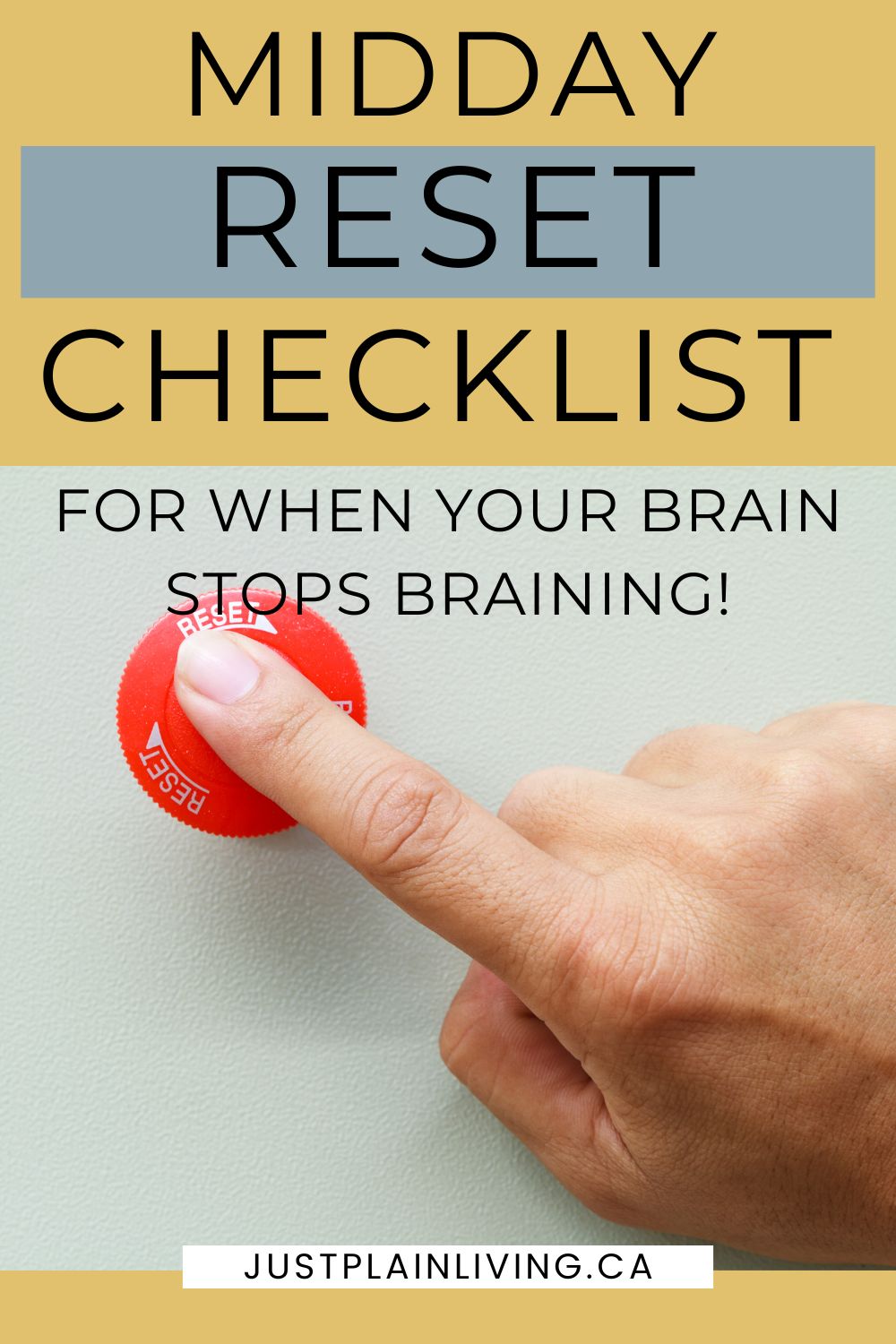
The Midday Reset Checklist (for When Your Brain Stops Braining)

June 3, 2025 by marie Leave a Comment

Let’s set the scene.

You’re halfway through the day. You’ve got 57 tabs open, physically and mentally. The kitchen’s a crime scene, there’s laundry breeding in the hallway, someone needs something again, and your brain?

Your brain just said, “What if we thought about that super awkward conversation from 2009 right now?” And you’re like, “Sure, sounds productive.”

Before you spiral further into becoming a feral goblin, let’s hit pause and do a midday vibe check. Because sometimes – especially if you’re sleep-deprived, overwhelmed, or your stress level just cranked up – you forget the basics that keep your squishy meat suit operating.

So here it is. A totally unserious, completely essential checklist to keep your day from nose-diving into chaos.

Future Me and Past Me Have a Problem

Future Marie and Past Marie are in a bit of a toxic situationship. Present Marie is just sitting in the middle like a beleaguered therapist. Can you relate?

“Okay, Past Marie, why didn’t you boil those eggs yesterday?”
“Because I was busy disassociating in the laundry room, okay?”
“Well, Future Marie is now low blood sugar, dizzy, and hissing at the children.”
“Not my problem.”

THE NEUROSPICY DAILY RESET CHECKLIST
(Because Present Me is sick of being the rope in this time-tug-o-war)

  • Have I eaten? Like, real food? Coffee doesn’t count unless it contains at least one egg.
  • Have I peed in the last 4 hours?
  • Do I know where my water bottle is?
  • Has the salt gods been appeased?
  • Do I feel more like a raccoon than a human? (This might be fine. You do you.)
  • What’s one tiny thing I can do to make Future Me say “oh yay” instead of “oh no”?
  • Did I move? Even a wiggle? Even dancing to one meme audio?
  • Do I need a nap, or do I need protein? (Flip a coin if unsure.)

Screech. Halt. Coffee with an Egg?

You know, I always feel weird when I tell people about this, but it’s delicious and it keeps me going for a long time. If a keto bro, a Vietnamese auntie, and a Hogwarts potions professor collaborated, this is what they’d make.

Here’s how I make my coffee:

Crack 1 (sometimes 2) egg in a large mug. Stick my immersion blender in and beat it well. Add 1 teaspoon monkfruit, 1 teaspoon MCT Oil, 1 teaspoon butter. Beat that in really well. Slowly add hot coffee while pulsing with the immersion blender. Don’t blend too much or it’ll swoosh over the top of the mug.

With one egg, it’s about 150 calories, 14 grams fat, 6.6 grams protein, and only 1 gram carbs.

Yes, you’ll still have to eat something solid during the day. I’m sitting here at 2:30 as the kids arrive from school and I realize that’ s the last thing I ate. Present Marie needs to go make some hardboiled eggs since Past Marie neglected to do the thing.

💦 If You Didn’t Pee, You’re Not Drinking Enough

Fun fact: The average human pees every 3–4 hours. If you just blinked and realized it’s been, like, seven… that’s a problem. Unless you’re doing a Lord of the Rings movie marathon and have just merged with the couch, you probably aren’t drinking enough water.

And that? That does bad things to your brain. Like, executive dysfunction levels go from “mild chaos” to “I forgot I was making toast two hours ago and now it’s a small black Frisbee.” Your body is 60% water, give or take. If you don’t refill it, your brain turns into a dusty attic full of squirrels and guilt.

So be kind to yourself. Pause. Pee. Hydrate. Repeat. Trust me – Future You will thank you (probably from the bathroom).

🫙 Where’s Your Water Bottle?

Let’s not get bogged down in semantics – maybe it’s a water bottle, maybe it’s a chipped mug that says “World’s Okayest Human,” maybe it’s an old jam jar with vibes. The point is: WHERE IS IT?

If you haven’t peed recently (see above 👀), I bet the thing that holds your water is not within arm’s reach. This is not a coincidence. Out of sight, out of bladder.

So go on. Find it. Refill it. Give it a little rinse if it’s starting to smell like last week’s regrets. Then put it next to you like a loyal hydration goblet. Because yes, your water bottle loves you. It just wants to see you succeed, glow, and pee at healthy intervals.

🧂 All Hail the Salt Gods

Let’s be real: Without salt, you will die. No, that’s not dramatic – it’s biochemistry. Your muscles need sodium to contract, your nerves need it to fire, and your cells need it to not shrivel up like raisins in the sun. So yes, you NEED SALT.

But somehow, we’ve built this weird cult of fear around salt – like it’s the white powder devil sneaking around in your food waiting to give you a heart attack.

And look, that might be true… if your entire diet is frozen pizzas and shelf-stable spaghetti in a can. That’s not appeasing the salt gods—that’s sacrificing yourself on their altar.

If you eat anything close to real food – heck, even if you just try to eat real food most of the time – especially on keto, carnivore, or anything low-carb, you need to actively chase salt just like your ancestors did. You’re flushing it out faster than a toddler with a new water gun, and if you don’t replace it, you’ll feel like death.

Headaches.

Fatigue.

Crankiness.

Nausea.

Your body will scream, “Please, I am just a humble bag of meat and water, and I crave the sacred crystals.”

So go ahead – honour the Salt Gods. Bless your roast with sea salt. Whisper sweet nothings to your electrolytes. And stop feeling guilty for salting your eggs.

🦝 Racoon or Human? (Honestly?)

It’s midday. You’re disheveled, mildly twitchy, and just made a weird noise when you stood up. You’ve been hunched over your tasks like a gremlin. Your hair is doing that thing. You know the one. How do I know – because I hit hyper-fixation mode and do the same thing.

So let’s pause for a second and ask: Is your body throwing up any engine lights?

  • Shoulders up around your ears?
  • Eyes dry?
  • Spine making “Rice Krispie” sounds?
  • Heart doing that fluttery “I drank coffee but forgot to eat” thing?
  • Emotional state: ✨feral✨?

Cool cool cool. That doesn’t mean you’ve failed at being a person. It just means it’s raccoon o’clock, and it’s time to make some choices.

Here’s what you can do:

🛌 Nap
Video games can wait. Your soul cannot. Go pretend to be a dramatic Victorian lady (regardless of gender). “I must to my bed!”

🎮 Or play that game.
The cozy one. The chaotic one. Mine is Sims 4 and I make their lives miserable. Or sometimes I lose an hour getting that porch just right. EJ prefers vampire games where he kills all sorts of digital bad guys. Whatever. You know what you need.

☀️ Or – and this is bold – step outside.
No, really.

Outside.

Touch grass.

Let the sun hit your skin.

Stare blankly into the sky like the solar-powered cryptid you are. (Not at the sun, at the sky.) Even five minutes of daylight can reset your brain. It’s like hitting Control-Alt-Del on your mood.

🙈 Or do absolutely none of the above and doom scroll until your brain resets.
Look, I’m not here to shame your coping methods. But if you do choose this route, at least get some water while you scroll, yeah? And set a timer because that stuff can suuuuuuuck you in.

Midday vibe checks aren’t about judgment – they’re about noticing.
Noticing that you’re running on fumes, that your inner raccoon is steering the ship, and that maybe, just maybe, it’s time to kindly tuck her in for a nap and let the human drive for a while.

🔮 Do Something for Future Me

Here’s the deal. We’re not aiming for grand gestures here. No one’s asking you to organize your taxes or alphabetize your spice rack by terroir. (Unless that sparks joy, in which case … I see you and am amazed by you.)

We’re talking tiny, merciful acts of kindness for your future self. The kind that make you stop mid-chaos tomorrow and go, “OH bless you, Past Me, you absolute legend.”

You know what I’m talking about:

☕ Prepping the coffee pot the night before.
Morning Me is a mess. Morning Me has no fine motor skills and really doesn’t want to be awake this earlier anyway. So Past Me, in her 10pm glory, scoops the grounds and fills the water. All hail her.

🍽️ Throwing supper in the slow cooker early.
Future Me at 3pm is spinning like a Sims character about to pee their pants. But Present Me? Present Me fried the steaks this morning and dumped them in the Crock-Pot. That’s right. Dinner is handled. Chef’s kiss. Kids can do the dishes.

👟 Putting shoes by the door.
Because Future Me will absolutely spend 10 minutes yelling “Where are my shoes?!” at a wall. This avoids that. Also applies to hanging up my purse on the hook my husband put up just for my purse. You’d be surprised how hard it can be to find a giant purple purse.

🧻 Refilling the toilet paper.
This one’s heroic. Truly. Past You deserves a statue.

💻 Closing tabs. Writing a sticky note. Plugging in your devices.
They’re all love letters to Future You, signed: “I remembered you exist.”

And hey—some days, “doing something for Future Me” might be:

🧸 folding two towels
🥚 boiling three eggs
🧂 refilling the salt container
🛏 pulling the clean sheets back before bedtime

So take a moment. Scan your world. Ask:
“What will make Future Me breathe a little easier?”

Then go do just one thing. That’s it. That’s the magic.

💃 Did You Move That Booty (Even a Little Bit)?

Look, I’m not here to shame anyone for fusing with the couch. I love that couch. That couch knows all my secrets.

But also: our bodies were not designed to sit in the same exact position for seven hours straight like a depressed gargoyle with WiFi.

Have you moved today?

No, not pee movement – we covered that and it’s not enough. I mean, did you:

  • Stretch even slightly?
  • Stand up for two minutes and shake out your limbs like a wet dog?
  • Do a kitchen dance while waiting for your coffee to brew?
  • Run up the stairs with the smug energy of someone who remembered laundry before the mildew kicked in?

Because your muscles? They’re petty. They hold grudges. If you ignore them, they go full union protest like:

“No glute activation today? Cool, we’ll just hurt tomorrow when you reach for a pencil. Good talk.”

They’re big on “use it or lose it” – which is a crap retirement plan if you ask me, but here we are.

And let’s not forget the other kind of movement. Yes, I’m talking about… 💩 poop.

Movement (body-type) helps with movement (bathroom-type). It’s all connected.

Feeling a little clogged up and cranky? Shake your tail feathers. Take a walk. Do a lunge. Wiggle weird in the kitchen while your cat judges you.

So, vibe check:

  • Have you stood up recently?
  • Have you moved anything that isn’t your scrolling thumb?
  • Can you do literally one stretch right now? Arms over head. Big breath. Shake the tension out. Boom. You moved. You did it.

Future You’s hip joints thank you.

😤 Do You Need Protein, a Nap, or to Go Poop?

There comes a point in every day – usually sometime between “the coffee wore off” and “why is my skin itchy and reality bendy” – when the world stops making sense and your brain just starts screaming like a haunted fax machine.

Come on, admit it. I’m not the only one who experiences that.

When that happens, pause and ask yourself:

🥩 Do You Need Protein?

Low blood sugar is a sneaky little gremlin. It doesn’t always show up like hunger. Sometimes it’s:

  • Crying over a commercial about cheese
  • Sudden rage at the way someone is chewing
  • Forgetting how to do things you literally do daily

Especially if you’re low-carb, keto, or carnivore, you need a solid hit of protein + fat to get your brain back online. Not a rice cake. Not air. Not vibes. Real food.

Old Mom Wisdom™: Pre-boiled eggs are magic. Slices of cold steak soothe your nerves. You can literally eat peanut butter by the spoon and no one will stop you.

🛏️ Do You Need a Nap?

Listen, I know. Naps are for kids. Except they’re not. They’re for overstimulated, exhausted meat robots running on cortisol and iced coffee. That’s us, babes.

Sometimes your body isn’t hungry or sick or broken – it’s just TIRED. Like, “system shutting down, please plug in brain for updates” tired. A 20-minute lie down can work miracles.

Make it a blanket burrito with cat attachment. Maximum recharge. Everyone knows a purring cat heals everything.

🚽 Do You Need to Go Poop?

This one’s the sleeper agent. You think you’re having an existential crisis, but really your colon just has unfinished business.

Kids get cranky when they need to poop. So do adults – we just get weird about admitting it.

You don’t need therapy, a breakup, or to burn your life down. You just need to go poop.

💩 Seriously.

If you’re pacing, annoyed, uncomfortable in your own skin, and nothing’s helping – have a big glass of water, then go sit on the toilet. Bring your phone or a book. Wait it out.

It’s not always mental health. Sometimes it’s a biological process being very behind schedule.

This isn’t a joke. I’m an old mom. I’ve seen things. Trust me – when in doubt, try pooping.

So next time your whole vibe goes off the rails?

Pause. Ask yourself: “Do I need protein, a nap, or to go poop?”

Odds are, the answer is yes to at least one.

And maybe, just maybe, that’s what gets you through the day instead of rage-quitting life and becoming a forest cryptid.

🧚‍♀️ Final Thoughts

You don’t have to do it all. Just check in with yourself like you would a kid you love.

Are you fed? Hydrated? Warm? Uncrunched?

This is not a productivity checklist. It’s a survival vibe check. Because sometimes your brain stops braining and you forget that you are a creature with needs, not just a floating anxiety ghost with thumbs.

So if you’re reading this in a half-dissociated haze, unsure where the day went—pause.

Do one thing from this list.

Then maybe another.

Then maybe take a nap.

And if you’re still overwhelmed, remember: You can always become a forest cryptid. But you don’t have to do it today.

Filed Under: Survive and Adapt

Primary Sidebar

Latest news

  • 10 Foods to Boost Vitamin K
  • So You Just Got a Goat! Essential Goat Care Tips
  • The Low FODMAP Way to a Healthy Gut

The Mission

Just Plain Living cuts the crap and gets real about neurodivergence, executive dysfunction, and parenting chaos. No fluff—just honest, practical life hacks for messy, beautiful living.

Recent Posts

  • 10 Foods to Boost Vitamin K
  • So You Just Got a Goat! Essential Goat Care Tips
  • The Low FODMAP Way to a Healthy Gut
  • 5 Lesser Known Superfoods You Should Try
  • Benefits of Elderberry: Why You Need this Superfood

Recent Comments

No comments to show.

Recent Posts

  • 10 Foods to Boost Vitamin K
  • So You Just Got a Goat! Essential Goat Care Tips
  • The Low FODMAP Way to a Healthy Gut

Copyright © 2026 · Niche Theme

Copyright © 2026 Marie Campbell Beausoleil